0121 384 3244
Book Online
Some of the most common foot problems in children are:
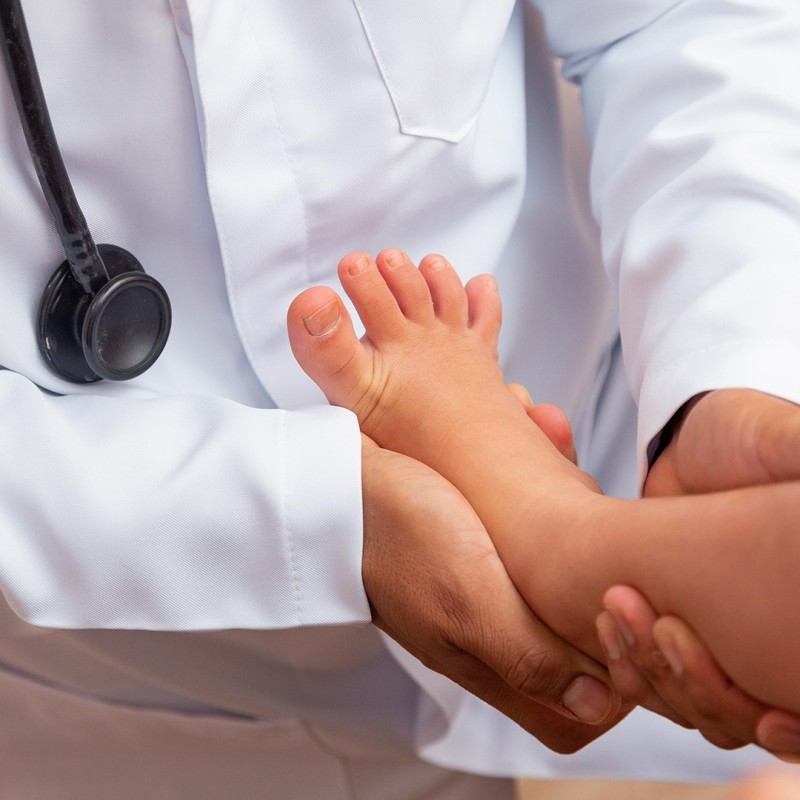
At an examination, children are assessed with their parents present. Your podiatrist will then give advice on the appropriate management for the condition at hand. Correct footwear in terms of fitting and style is essential for children. Sometimes orthotics (shoe inserts) may be necessary to manage how the foot relates to the ground and ensure structural safety.
Although many more adults suffer from heel pain, children do as well. Although the leading cause of heel pain in adults is plantar fasciitis, the leading cause of pediatric heel pain is something called Calcaneal Apophysitis, or Sever's Disease.
The condition is an inflammation of the growth plate (apophysis) of the heel bone (calcaneus).
The strong Achilles tendon inserts along the back of the heel and attaches to the bone that is between a secondary growth centre of the heel bone. The heel bone has two growth centres. The primary growth centre is located in the middle of the heel bone. Growth centres start out as cartilage and then eventually turn into bone as the bone matures.
When looking at an x-ray of a growing child's foot, you will see two boney islands separated by a boney gap that represents the secondary growth plate (physis) at the back of the heel.
In some children (mainly active children), the Achilles tendon will irritate the secondary growth plate and produce pain. It is believed that the cause is due to overuse or micro-traumas that the tendon places on the bone during activity.
It is more common to see this problem when the child is playing on hard surfaces a lot such as a basketball court or a hard, dry sports field. In addition, a tight calf muscle or Achilles tendon will irritate the secondary growth plate more aggressively than a tendon that is not tight.
The child will complain of pain in the back of the heel or along the bottom of the heel, during or after athletic activities. In addition, the heel pain is aggravated when the back of the heel is squeezed. High impact activities such as running or jumping will also exacerbate the problem. One or both heels can present pain, and the pain may be so acute that the child has a noticeable limp.
Firstly x-rays will be taken to rule out any other causes of heel pain. Other Causes of heel pain in children include fractures and tendon-achillies bursitis. For those over 14, overuse injuries such as achilles tendonitis or plantar fasciitis need to be ruled out.
The best advice for any child suffering from heel pain is to eliminate high impact activities for two to four weeks. We will also fit the child for a heel lift cup, which is made of soft silicon, and advise them to avoid going barefoot. Gentle stretching of the calf muscle is also helpful, as is icing and a Biofreeze application. Icing the heel three times a day for 20-30 minutes at a time has been known to deliver positive outcomes.
A custom functional foot orthotic with a heel lift is highly advised when the child has a pronated or flat foot. In more stubborn cases, oral or topical non-steroidal anti-inflammatory medications are helpful. In the worst cases, an air cast immobilisation boot will be recommended.
If your child is complaining of pain in their feet, you should have them assessed by a foot care professional like ourselves as soon as possible. If you would like to book an appointment, then look no further; we will be happy to help put that spring back in your child's step.
Call on 0121 384 3244 Book An Appointment