0121 384 3244
Book Online
No "Bathroom Surgery" is an absolute must.
Don't be tempted to "have a go" at treating your ingrown toenail with your trusty nail cutters or scissors. You may end up doing more damage to the area and possibly even spreading the infection that's already present. The end result is that you may increase rather than decrease the pain you're experiencing!
In order to help clear the area of pus or dried blood (if present), it's best to soak your toe in lukewarm (not hot!) saltwater for 15-20 minutes once a day. Simply place a teaspoon of table salt in a small container of warm water. After each soaking session, gently dry the area and place an antiseptic (e.g. Savlon) on the area, followed by applying a small piece of sterile gauze and a plaster. As soon as possible, you should make an appointment with a podiatrist to have this treated properly.
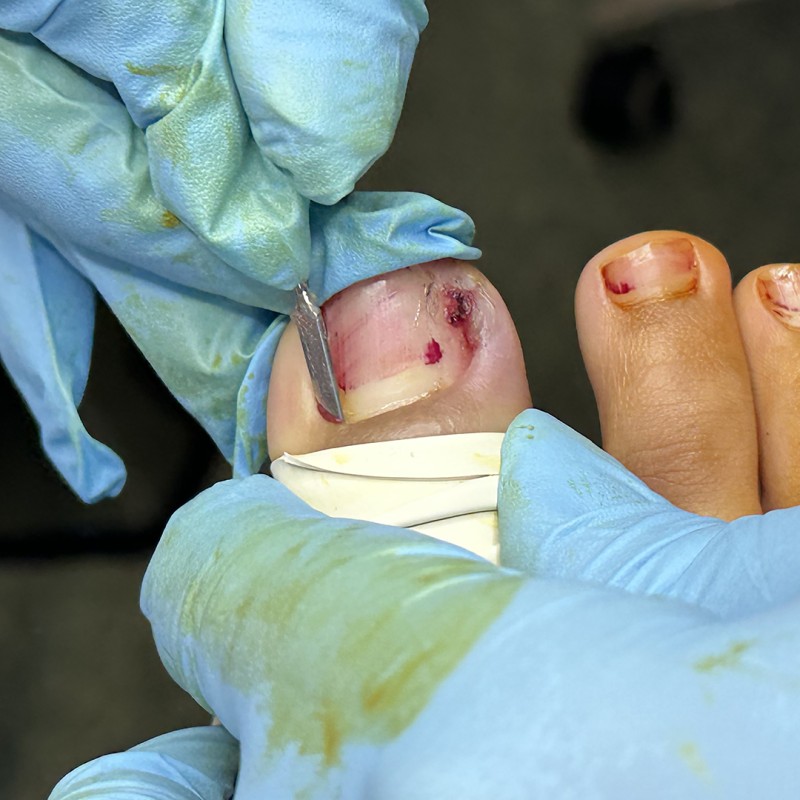
You'll be asked to complete a health questionnaire prior to your initial visit. This is very important since your treatment may be influenced by your current health and/or medications. The level of treatment you require depends on the severity of the ingrown toenail. For the most basic painful in-growing toenail (usually a first-time occurrence), the offending spicule of the toenail will be removed.
A local anaesthetic will be administered beforehand if the toe is particularly tender.
For those of you with "needle-phobia," don't worry—we use a freezing spray to numb the skin before the injection of an anaesthetic. And forget any horror stories you may have heard about injections directly into the ingrown toenail. This is simply unnecessary and causes needless pain. By knowing the anatomy of the toe, we place the anaesthetic well away from the painful area. Then, once the anaesthetic is in place, you won't feel any discomfort whatsoever.
Our philosophy of practice dictates that we will not allow any of our patients to "suffer through" any treatment or surgery. Once the offending nail spicule is removed, we may or may not give you a brief note to take to the pharmacist to get a course of appropriate antibiotics. If this is recommended, it is because our examination reveals significant tissue infection present or even mild infection in a patient with diabetes or poor circulation. If you have diabetes, having any form of foot-related injury could be very serious. Even a basic injury could lead to amputation if the injury is not promptly treated.
Nail surgery is a minor surgical procedure to remove all or part of your toenail. It is usually required when an in-growing toenail is frequently recurring. Minor surgery is a relatively simple procedure and is a permanent solution to the problem.
Local anaesthetic is injected into your toe; this makes the toe numb, blocking all pain sensation during the procedure. When your toe is numb, a band is placed at the toe's base to help reduce bleeding. The offending piece of nail or whole nail is then removed. A chemical called phenol is applied to the nail germinal matrix to prevent unwanted re-growth of part or the entire nail.
Care has to be taken in the first few weeks after the surgery to help prevent infection. The whole procedure generally takes an hour to complete and is an efficient, successful solution to in-growing nails.
After the surgery, you will need to keep your foot elevated for a few hours and rest. You can return to work or school the following day. It is advised that you refrain from sports and running for at least two weeks. Healing time varies depending on your age and general health, but it is generally 4 to 12 weeks.
If you have a chronic or recurring problem with an ingrowing toenail, your best option would be to have the offending incurvated nail spicule permanently removed.
Call on 0121 384 3244 Book An Appointment