
0121 384 3244
Book Online
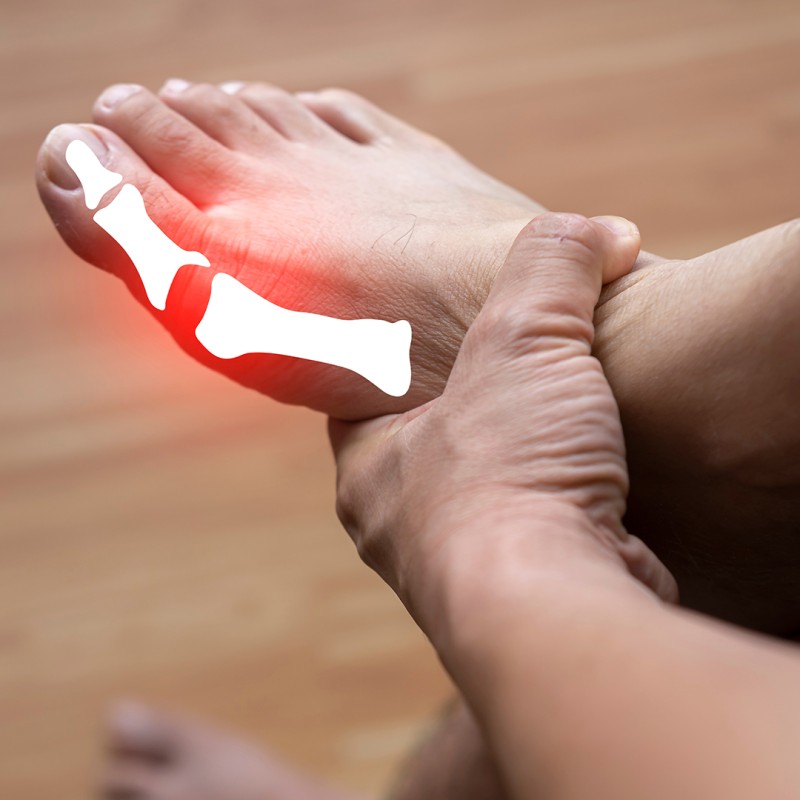
Each day, with every step you take, your big toe bears a tremendous amount of stress—a force equal to about twice your body weight. Most of us don’t realize how much we use our big toe. We tend to take it for granted unless a problem develops. One problem that afflicts the big toe is called hallux rigidus, a condition where the movement of the toe is restricted to varying degrees. This disorder can be very troubling and even disabling since we use the all-important big toe whenever we walk, stoop down, climb up, or even stand. If you have pain and/ or stiffness in your big toe, you may have this condition.
Hallux rigidus is a disorder of the joint located at the base of the big toe. It causes pain and stiffness in the big toe, and it gets increasingly harder to bend the toe with time.
“Hallux” refers to the big toe, while “rigidus” indicates that the toe is rigid and cannot move. Hallux rigidus is a form of degenerative arthritis (a wearing out of the cartilage within the joint in the foot and other parts of the body).
Because hallux rigidus is a progressive condition, the toe’s motion decreases as time goes on. In its earlier stage, the motion of the big toe is only somewhat limited at that point; the condition is called “hallux limitus.” But as the problem advances, the toe’s range of motion gradually decreases until it potentially reaches the end stage of “rigidus”. Where the big toe becomes stiff, or what is sometimes called a “frozen joint.” Other problems are also likely to occur as the disorder progresses.
Early signs and symptoms include:
As the disorder gets more serious, additional symptoms may develop:
Common causes of hallux rigidus are faulty function (biomechanics) and structural abnormalities of the foot that can lead to osteoarthritis in the big toe joint. This type of arthritis—the kind that results from “wear and tear”—often develops in people who have defects that change the way their foot and big toe functions. For example, those with fallen arches or excessive pronation (rolling in) of the ankles are susceptible to developing hallux rigidus.
In some people, hallux rigidus runs in the family and is a result of an inheriting foot type that is prone to developing this condition. In other cases, it is associated with overuse—especially among people engaged in activities or jobs that increase the stress on the big toe, such as workers who often have to stoop or squat.
Hallux rigidus can also result from an injury, even from stubbing your toe. Or certain inflammatory diseases, such as rheumatoid arthritis or gout, may cause it. At the Footfix Clinic, our podiatrists can determine the cause of your hallux rigidus and recommend the best treatment.
The sooner this condition is diagnosed, the easier it is to treat. Therefore, the best time to see a podiatrist is when you first notice that your big toe feels stiff or hurts when you walk, stand, bend over, or squat. If you wait until bone spurs develop, your condition is likely to be more difficult to manage.
In diagnosing hallux rigidus, we will examine your feet and manipulate the toe to determine its range of motion. X-rays are usually required to determine how much arthritis is present as well as to evaluate any bone spurs or other abnormalities that may have formed.
Non-Surgical Approaches
If your condition is caught early enough, it is more likely to respond to less aggressive treatment. In many cases, early treatment may prevent or postpone the need for surgery in the future. That’s why it is essential to see us at the Footfix clinic when you first begin to notice symptoms. This way we can accurately diagnose your problem and try to prevent it from getting worse.
Treatment for mild or moderate cases of Hallux Ridgidus may include one or more of these strategies:
Shoe Modifications - Shoes with a large toe box should be worn because they put less pressure on your toe. Stiff or rocker-bottom soles may also be recommended. You should also try to stop wearing high heels and tight-fitting shoes.
Orthotics - Custom orthotic devices will improve the function of your foot and assist in the fitment of your shoes, providing ample arch support and support for your toe.
Medications - Non-steroidal anti-inflammatory drugs (NSAIDs), such as ibuprofen, may be advised to help reduce pain and inflammation. Supplements such as glucosamine-chondroitin sulfate and some vitamins and minerals may also be helpful.
Injection Therapy - Injections of corticosteroids in small amounts are sometimes given to the affected toe to help reduce inflammation and pain.
Physical Therapy - Ultrasound therapy or other physical therapy modalities may be undertaken to provide temporary relief.
In some cases, surgery is the only way to eliminate or reduce the pain caused by hallux rigidus. We will refer you directly to our Foot and Ankle Surgeon for a private consultation if you require surgery.
These surgical procedures fall into two categories:
Some procedures reconstruct and “clean up” the joint. The surgeon removes the arthritic damage from the joint and any accompanying bone spurs and then alters the position of one or more bones in the big toe. These procedures are designed to preserve and restore normal alignment and function of the joint as well as reduce or eliminate pain.
More aggressive procedures are used when the joint cannot be preserved. These may involve fusing the joint, removing part or all of the joint and, in some cases, replacing it with an implant. These procedures eliminate painful motion in the joint and provide a stable foot.
The procedure used to correct hallux rigidus depends on many factors, including the cause of the condition and the severity, as well as the patient’s age, occupation and activity level. If surgery is performed, the length of the recovery period will vary, depending upon the procedure or procedures performed.
Call on 0121 384 3244 Book An Appointment